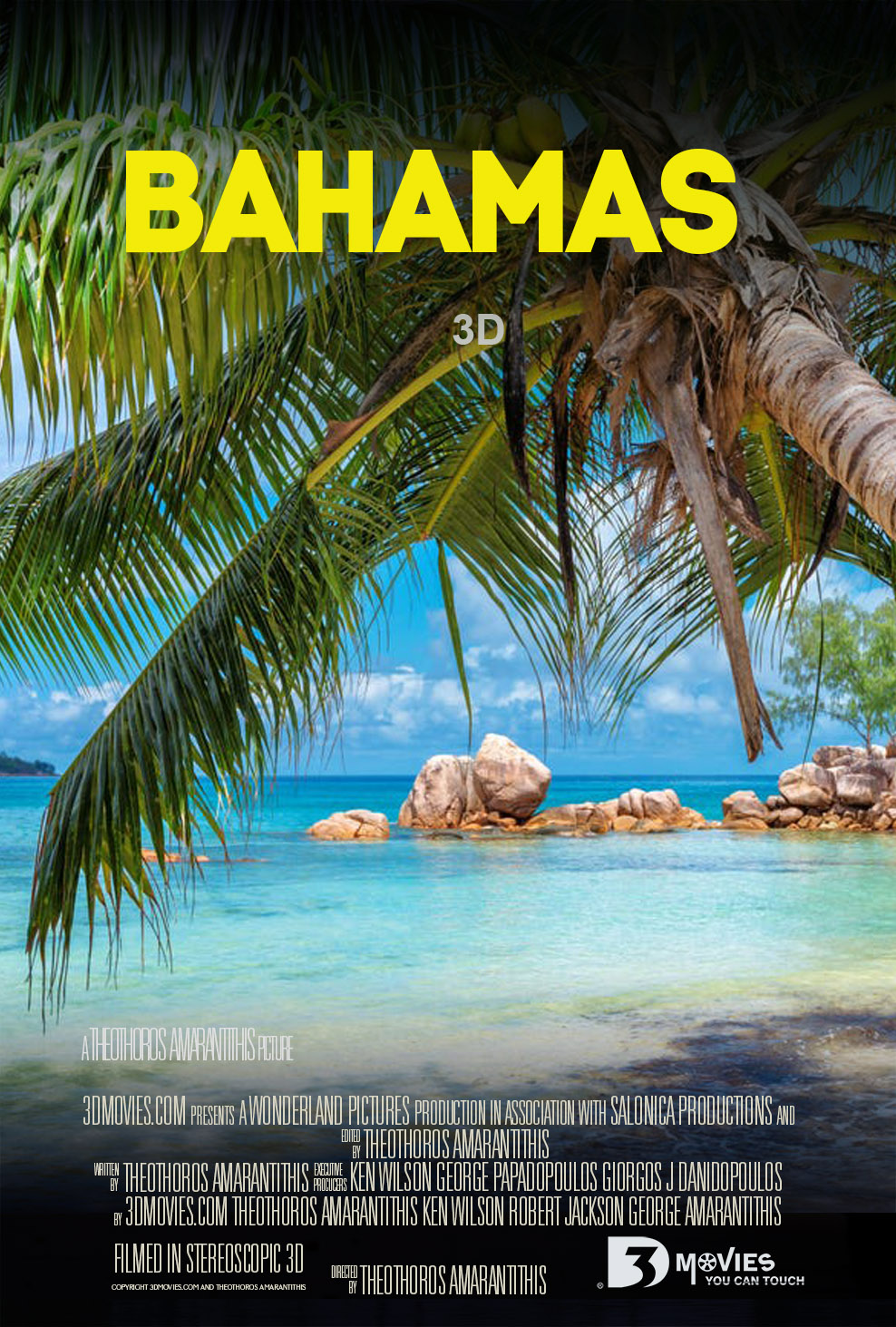
Bahamas

It’s better in the Bahamas!

The Bahamas (officially the Commonwealth of the Bahamas), is a nation consisting of 29 islands, 661 cays, and 2,387 islets (rocks). It is located in the Atlantic Ocean north of Cuba and Hispaniola (Dominican Republic and Haiti), northwest of the Turks and Caicos Islands, and southeast of the United States (nearest to the state of Florida). Its total land area is 13,939 km2 (5,382 sq mi), with an estimated population of 330,000. Its capital is Nassau. Geographically, The Bahamas lie in the same island chain as Cuba, Hispaniola and the Turks and Caicos Islands; the designation of Bahamas refers normally to the Commonwealth and not the geographic chain.
Bahamas documentary in Blue-Ray 3D DVD is coming soon!
Originally inhabited by the Lucayans, a branch of the Arawakan-speaking Taino people, The Bahamas were the site of Columbus’ first landfall in the New World in 1492. Although the Spanish never colonized The Bahamas, they shipped the native Lucayans to slavery in Hispaniola. The islands were mostly deserted from 1513 to 1648, when English colonists from Bermuda settled on the island of Eleuthera.

Hot and sunny all year! That’s Bahamas!
The Bahamas became a Crown Colony in 1718 when the British clamped down on piracy. Following the American War of Independence, thousands of pro-British loyalists and enslaved Africans moved to The Bahamas and set up a plantation economy. The slave trade was abolished in the British Empire in 1807 and many Africans liberated from slave ships by the Royal Navy were settled in The Bahamas during the 19th century. Slavery itself was abolished in 1834 and the descendants of enslaved and liberated Africans form the bulk of The Bahamas’s population today.
In terms of GDP per capita, the Bahamas is the third richest country in the Americas (following the United States and Canada), the richest south of the Mexico–US border, and the richest in the world whose population is predominantly of African origin.

History of The Bahamas
Taino people moved into the uninhabited southern Bahamas from Hispaniola and Cuba around the 11th century AD. These people came to be known as the Lucayans. There were an estimated 30,000+ Lucayans at the time of Columbus’s arrival in 1492. Christopher Columbus’s first landfall in the New World was on an island named San Salvador (known to the Lucayans as Guanahani), which is generally accepted to be present-day San Salvador Island, (also known as Watling’s Island) in the southeastern Bahamas.
An alternative theory holds that Columbus landed to the southeast on Samana Cay, according to calculations made in 1986 by National Geographic writer and editor Joseph Judge based on Columbus’s log. Evidence in support of this remains inconclusive. On the landfall island, Columbus made first contact with the Lucayans and exchanged goods with them.
The Lucayans throughout The Bahamas were wiped out as a result of Spanish forced migration of the population to Hispaniola for use as forced labour there, and exposure to diseases to which they had no immunity.[9] The smallpox that ravaged the Taino Indians after Columbus’s arrival wiped out half of the population in what is now The Bahamas.
It is generally assumed that the islands were uninhabited by Europeans until the mid-17th century. However, recent research suggests that there may have been attempts to settle the islands by groups from Spain, France, and Britain, as well as by other Amerindians. In 1648, the Eleutherian Adventurers migrated from Bermuda. These English Puritans established the first permanent European settlement on an island which they named Eleuthera—the name derives from the Greek word for freedom. They later settled New Providence, naming it Sayle’s Island after one of their leaders. To survive, the settlers resorted to salvaged goods from wrecks.
In 1670 King Charles II granted the islands to the Lords Proprietors of the Carolinas, who rented the islands from the king with rights of trading, tax, appointing governors, and administering the country. In 1684 Spain’s corsair Juan de Alcon raided the capital Charles Town, and in 1703 a joint Franco-Spanish expedition briefly occupied the Bahamian capital during the War of the Spanish Succession.
18th century
During proprietary rule, The Bahamas became a haven for pirates, including the infamous Blackbeard. To restore orderly government, The Bahamas were made a British crown colony in 1718 under the royal governorship of Woodes Rogers, who, after a difficult struggle, succeeded in suppressing piracy. In 1720, Rogers led local militia to drive off a Spanish attack.
During the American War of Independence, the islands were a target for American naval forces under the command of Commodore Ezekial Hopkins. The capital of Nassau on the island of New Providence was occupied by US Marines for a fortnight.
In 1782, following the British defeat at Yorktown, a Spanish fleet appeared off the coast of Nassau, and the city surrendered without a fight.
After American independence, some 7,300 Loyalists and their slaves moved to The Bahamas from New York, Florida, and The Carolinas. These Loyalists established plantations on several islands and became a political force in the capital. The small population became mostly African from this point on.
The British abolished the slave trade in 1807, which led to the forced settlement on Bahamian islands of thousands of Africans liberated from slave ships by the Royal Navy. Slavery itself was finally abolished in the British Empire on August 1, 1834.
20th century
Modern political development began after the Second World War. The first political parties were formed in the 1950s and the British made the islands internally self-governing in 1964, with Sir Roland Symonette of the United Bahamian Party as the first premier.
In 1967, Sir Lynden Pindling of the Progressive Liberal Party became the first black premier of the colony, and in 1968 the title was changed to prime minister. In 1973, The Bahamas became fully independent, but retained membership in the Commonwealth of Nations. Sir Milo Butler was appointed the first Bahamian governor-general (the representative of Queen Elizabeth II) shortly after independence.
Based on the twin pillars of tourism and offshore finance, the Bahamian economy has prospered since the 1950s. However, there remain significant challenges in areas such as education, health care, housing, international narcotics trafficking and illegal immigration from Haiti.
Yes, it’s always better in the Bahamas!